34 Organizations Urge French Government to Save Wikie and Keijo
By Mark J. Palmer
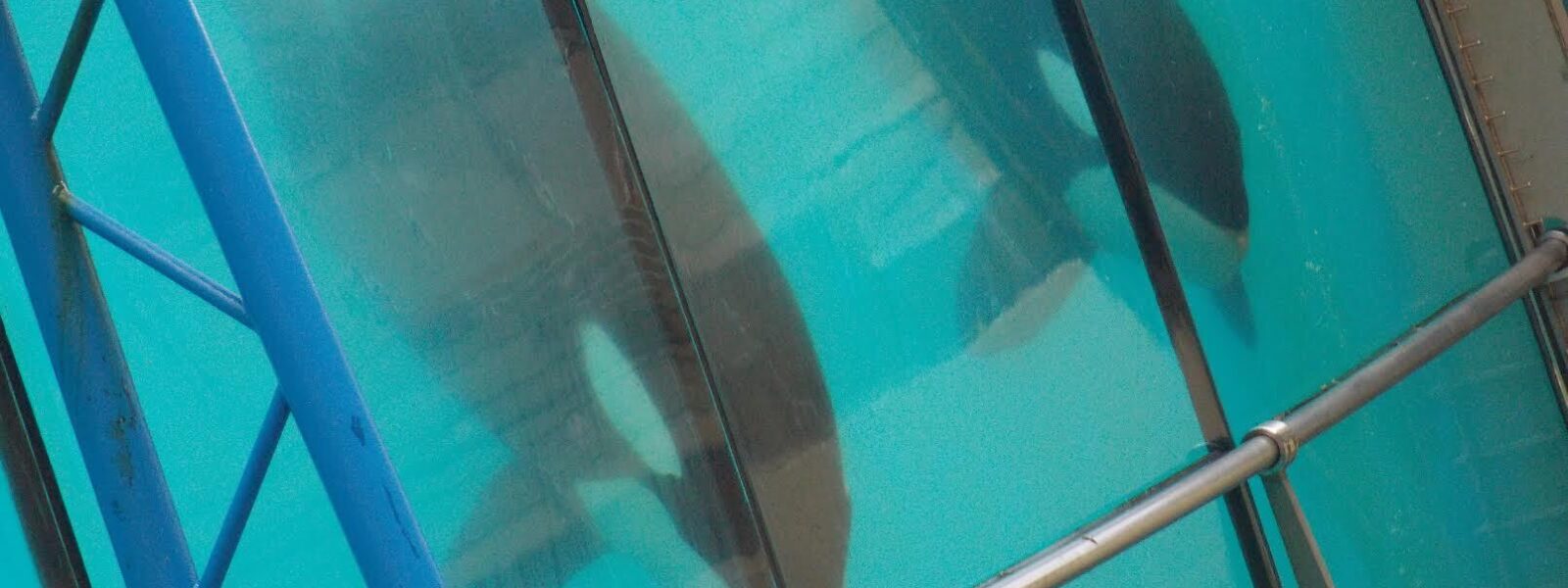
The French government remains in disarray, with another government falling just before the 2024 holidays, putting off a decision on the fate of two captive orcas in France, Wikie and her son Keijo. Both orcas reside at Marineland in Antibes, but the government wants the orcas moved out of France, ending the keeping of captive dolphins and whales in France for good. Marineland wants to send the orcas to a marine park in Japan with smaller tanks, and the French minister, while opposing the transfer to Japan, suggested the Loro Parque Zoo in Spain.
The International Marine Mammal Project (IMMP) of Earth Island Institute has been working with the Whale Sanctuary Project to promote retiring Wikie and Keijo to the new sanctuary being built in Nova Scotia waters. The sanctuary would provide life-long care for Wikie and Keijo (both born in captivity) in a large ocean area. They would be fed and receive veterinary care. A French inspector General issued a report over the summer recommending the Whale Sanctuary option for the two orcas. See our latest update.
IMMP joined forces with our friends at Marine Connection , a nonprofit organization working against cetacean captivity (among other issues) based in the United Kingdom, and good friends with IMMP for many years. We obtained sign-ons for our newest letter from 33 organizations plus Marine Connection, urging the new Minister, when appointed, to make a favorable decision for the orcas’ new home.
Here’s a copy of our letter:
20 December 2024
Cabinet de Madame la Ministre de la Transition écologique, de l’Energie, du Climat et de la Prévention des risques
PARIS, France
Dear Minister,
The undersigned 33 organizations from around the globe wish to convey our continued concerns regarding the future of the two orcas held at Marineland d ’Antibes.
We strongly endorse the Inspector General’s report recommendation that the best option for captive orcas Wikie and Keijo is their relocation to a seaside sanctuary. We strongly believe that the sanctuary option would provide the best health and welfare for these two orcas and this is also the option that coincides with the spirit and intent of the French law prohibiting the display and holding of captive cetaceans.
We also commend Mme Agnès Pannier-Runacher, Minister of the Ministry for the Ecological Transition, Energy, the Climate and Risk Prevention, for her public announcement rejecting the option of exporting the two orcas to Japan’s Kobe Suma Sea World facility (KSSW) due to Japan’s substandard animal welfare regulations. There are several compelling reasons why the option of relocating the orcas to this facility in Japan warranted rejection. First, KSSW’s tank capacity for additional orcas is grossly inadequate, offering less than one-fifth the volume of the French orcas’ current facility. KSSW would subject Wikie and Keijo to a forced breeding program, likely resulting in separation of mother and son. Moreover, Japan continues to permit and subsidize the commercial killing of dolphins and whales, practices that are fundamentally at odds with conservation principles and have been rejected by most countries of the world. Collectively, these issues contradict the spirit and intent of the 2021 French law.
Meanwhile, our organisations must express our urgent concerns with the option of relocating the two orcas to Loro Parque Zoo located in the Canary Islands. It is our collective view that Loro Parque Zoo option should be rejected as a relocation site for Wikie and Keijo. Relocating these orcas to Loro Parque Zoo would pose severe threats to their health and welfare.
We urge you to undertake investigations regarding the following issues:
1. Scientists and veterinarians have documented that Loro Parque Zoo has a poor track record relating to the mortality and welfare of orcas. Attached is a copy of a recent “The Case Against Transferring Orcas Wikie and Keijo to Entertainment Parks” by Heather Rally, DMV, Thrive Wild. We find it appalling that four orcas have died at their facilities since 2021.
2. Loro Parque Zoo uses artificial insemination as part of the forced breeding of orcas at their facilities. This practice has been prohibited in various countries including by SeaWorld in the USA and by Canada, as it is highly invasive and results in increasing the numbers of orcas held in inhumane conditions. Loro Parque Zoo has indicated that Wikie and Keijo would be part of their breeding programme.
3. Relocating Wikie and Keijo to Loro Parque Zoo runs the risk that these orcas will be subject to aggression from the more dominant orcas held at their facilities. This could result in injuries and stress that pose risk to their health and survival.
4. The orca Keto died at Loro Parque Zoo on 20 November, 2024. Loro Parque Zoo has thus far failed to provide a necropsy report documenting the cause of his death.
5. Loro Parque Zoo has a long history of lack of transparency and mischaracterization of incidents at their facility. This includes multiple instances of false representations by claiming that orca attacks on trainers were simply accidents. Also, when an orca calf was observed to be sick, Loro Parque Zoo falsely claimed that the calf was in perfect health.
These issues make clear that Loro Parque Zoo is an unacceptable choice for Wikie and her son Keijo. We request that the Ministry discards the option of relocating the two orcas from Marineland d’Antribes to Loro Parque Zoo.
We appreciate your consideration of these concerns. We consider this a matter of urgency because Marineland d ’Antibes has threatened to proceed with rapid export of the two orcas, despite an order from the Aix-en-Provence Court of Appeal not to relocate until the independent analyses of the health of the orcas have been completed.
Sincerely,
Margaux Dodds
Executive Director
Marine Connection
SUPPORTING ORGANIZATIONS
Animals Asia, UK
Animal Justice, Canada
Animal Legal Defense Fund, US
Born Free Foundation, UK
Brazilian Humpback Whale Institute
British Divers Marine Life Rescue, UK
Dolphin Connection, US
East Caribbean Coalition for Environmental Awareness
Freedom For Animals, UK
Free Morgan Foundation, Netherlands
Free Willy Keiko Foundation, US
Humane Society International/Europe
International Animal Rescue
Kettle Range Conservation Group, US
Kyma Sea Conservation & Research, Switzerland
LAV, Italy
OneKind, UK
Origami Whale Project, US
People for the Ethical Treatment of Animals, Inc., US
People for the Ethical Treatment of Animals Foundation, UK
PETA Deutschland e.V, Germany
PETA France
PETA Schweiz, Switzerland
Pro Wildlife, Germany
QUATRE PATTES, France
Stichting PETA Nederland
Terra Mar Research, US
Thrive Wild, US
Whale and Dolphin Conservation, UK, US & DE
The Whaleman Foundation, US
World Animal Protection
World Cetacean Alliance, UK
WHAT YOU CAN DO: