This Mother's Day, We'd Like to Introduce You to Juno
By Cindy Lowry, Maine Campaign Coordinator for North Atlantic Right Whales, International Marine Mammal Project
North Atlantic right whales are one of the most endangered species on the planet. Only about 380 remain. They all have a nickname, family, and a history that scientists have spent decades piecing together. This Mother's Day, we want to introduce you to one of them.
Meet Juno
Researchers first spotted Juno in 1986, swimming alongside a newborn calf. Because female right whales typically give birth for the first time between the ages of 10 and 20, scientists believe she may be 50 or even 60 years old now. She is named after the Roman goddess, chosen for the distinctive convex shape of her head, which researchers call a "Roman nose."
This past December, Juno was spotted again off the coast of Georgia with her ninth calf.
Juno's story mirrors what so many right whale mothers face. Several of her calves are confirmed or presumed dead. Her most recent calf before this season was spotted with severe propeller wounds on his head, mouth, and left lip. The calf was seen bleeding on multiple occasions over the weeks that followed. On March 2, 2024, Juno was sighted without her calf. The next day, the calf was found dead, washed up on Cumberland Island National Seashore in Georgia.
Against all odds, some of her calves have survived. Her offspring, Limulus, born in 1992, is a mother herself now, making Juno a grandmother.
A Dangerous Journey
Each year, mother-calf pairs begin moving northward from the calving grounds off the southeastern United States toward feeding areas in New England and Canada. Their paths run through some of the busiest, most heavily fished waters on the East Coast.
Mother and calf pairs are particularly vulnerable during this migration for two reasons. First, newborn calves are slow while they learn to swim and are still nursing. A mother right whale will not abandon her calf, which means the pair moves at the pace of the calf. Second, nursing mothers must eat large quantities of food to sustain both themselves and their calves, which means they spend more time near the surface and in feeding areas where threats are concentrated.
Vessel strikes and entanglement in fishing gear are the two leading causes of death and serious injury for the whales. More than 86 percent of right whales have been entangled at least once, and some as many as nine times. The vertical ropes connecting lobster and crab traps to surface buoys are nearly impossible for whales to detect as they swim through the water column. A rope can catch on a flipper, a tail, a jaw, and tighten over months, cutting into flesh and bone. And a vessel strike can happen in an instant, with no warning for the whale. Right whales have a low profile when they come to the surface, and can’t maneuver quickly in reaction to a ship nearby. For a mother with a slow-moving calf at her side, these risks multiply.
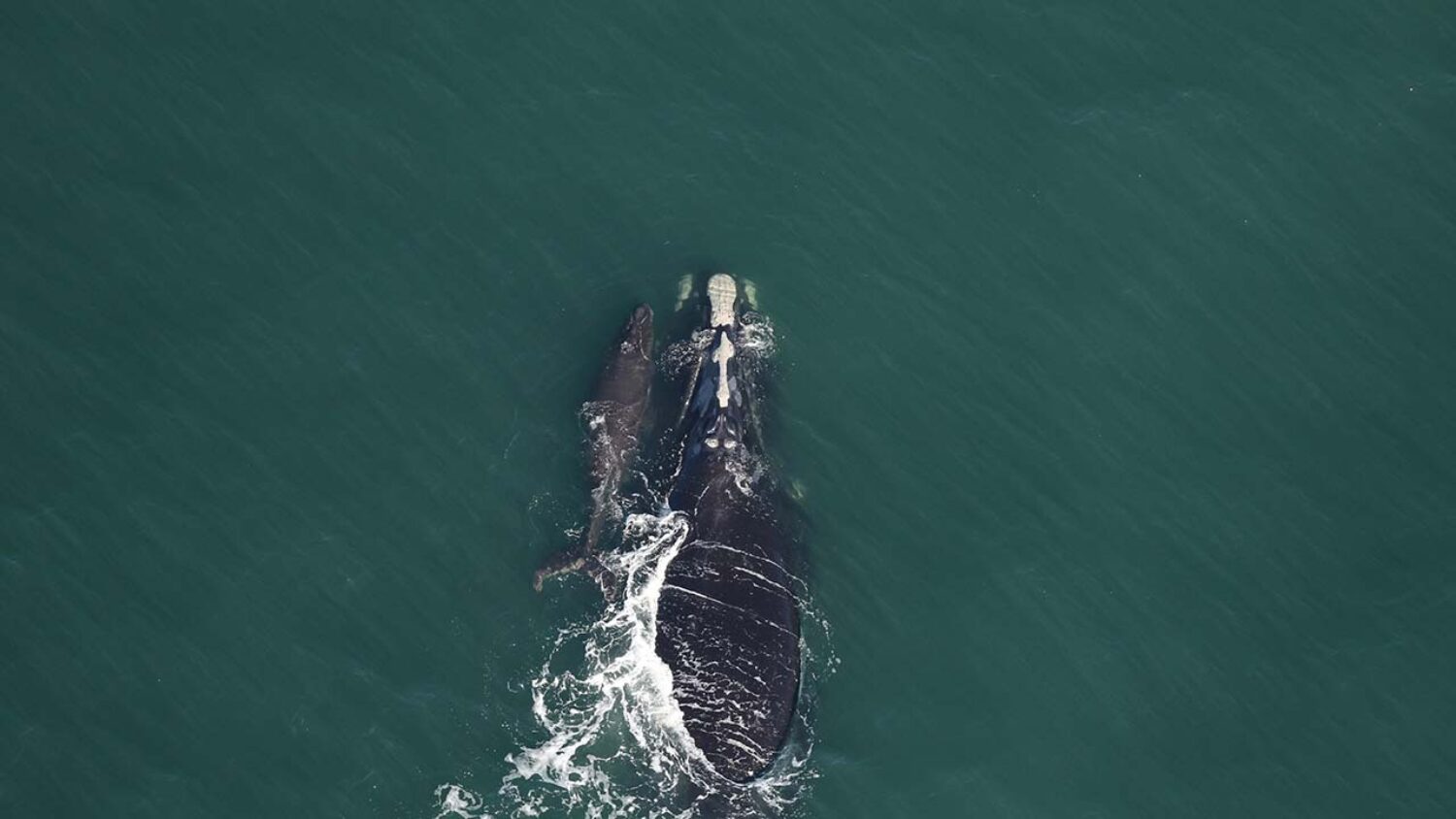
Juno with her latest calf, photographed last December. Photo Credit: Clearwater Marine Aquarium Research Institute, NOAA Permit #26919
Why Every Mother Matters
In a population of roughly 380 whales with only about 70 reproductively active females, every mother is essential. Lose a reproductive female, and you lose not just one whale, but every calf she might have had, every contribution to a lineage that could stretch decades into the future.
Juno has outlived five of her own offspring. She has given birth nine times in waters that have only become more dangerous over the course of her life. And this spring, she is making that northward migration again, with her newest calf at her side. Juno is proof that resilience exists. But resilience alone is not enough.
What We Can Do
This Mother's Day, we're thinking about Juno. Like all right whale mothers, she has done everything in her power to protect her calves. What she cannot do is protect them from the ropes and vessels we have put in their path.
Solutions exist. Ropeless, or "on-demand," fishing gear eliminates the vertical lines that entangle whales while allowing fishermen to continue their work. Vessel speed restrictions in critical habitat give whales a fighting chance when ships pass through their migration routes. (
IMPORTANT: More information on where you can submit comments upholding vessel restriction speeds in a subsequent blog.
Right now, Juno and her ninth calf are somewhere in the Northeast Atlantic, moving north through waters full of the very threats we have described. The question is whether we will finally act!
***************************************
The International Marine Mammal Project of Earth Island Institute is seeking donations to help support our efforts for the North Atlantic right whale, the Pacific gray whale, and other whales and dolphins all around the world. We’ve helped change the culture of the international tuna industry to protect dolphins from dying in tuna nets, and we’ve made great progress shutting down facilities that keep dolphins and orcas in captivity. Your support for whales and dolphins goes to help ensure whales and dolphins like the right whale will be here in the future. Thank you.