IMMP and CBD Launch Lawsuit to Protect Imperiled Gray Whales
Endangered Species Act Decision Overdue for Struggling Population
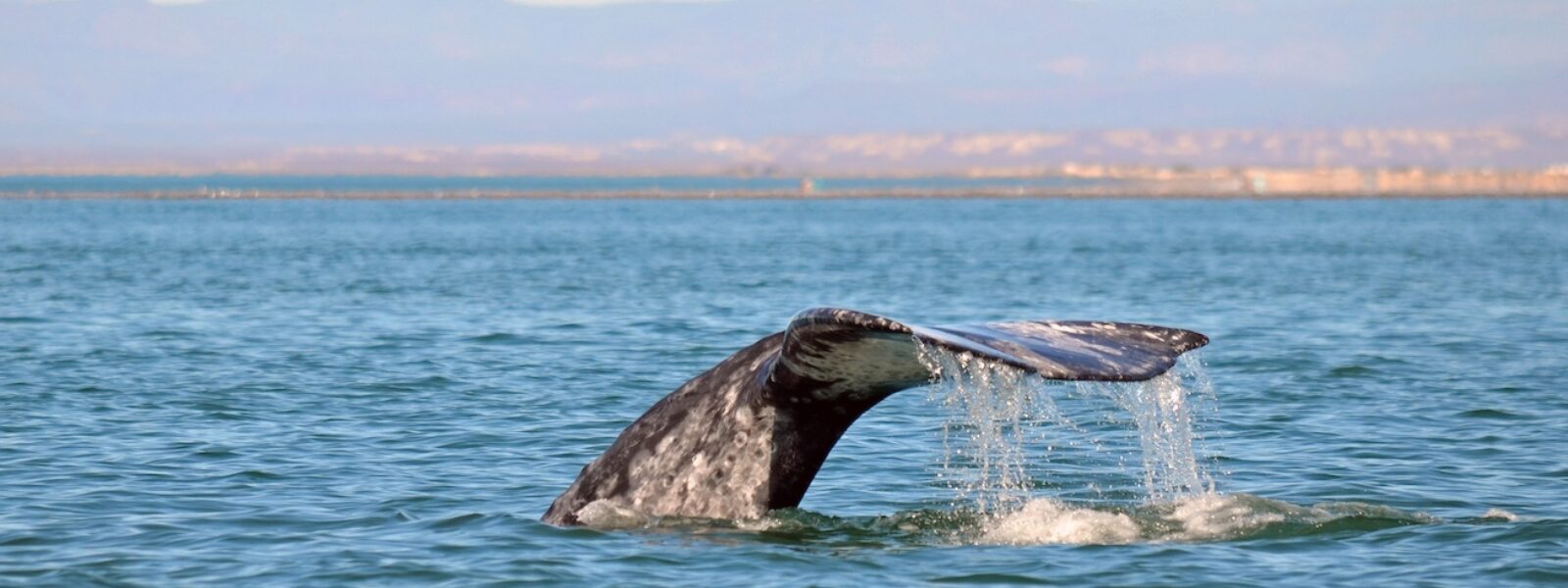
OAKLAND, Calif.— Three conservation groups today sent a notice of their intent to sue [https://www.earthisland.org/im...] the U.S. National Marine Fisheries Service for failing to issue a decision on Endangered Species Act protections for the Eastern North Pacific gray whale. This year there has been a catastrophic die-off of the whales along the West Coast.
In response to a 2025 petition to protect the whales, the Fisheries Service was required to decide by Aug. 24 whether listing this gray whale species under the Act is warranted.
“The Trump administration has once again broken one of the nation’s bedrock environmental laws — the ESA — by failing to respond to our August 2025 petition to list gray whales under the Act,” said Professor Rick Steiner, founder of Oasis Earth in Anchorage. “NOAA’s own science shows the gray whale population to be in grave danger due to Arctic climate change and other threats, and the government is now required to afford the whales all additional protections provided by the ESA.”
The Eastern North Pacific gray whale population has declined by as much as 50% in the past decade. This population of gray whales was protected under the Endangered Species Act until it was declared recovered and delisted in 1994. Unfortunately, the gray whale recovery was short-lived.
“We’ve lost half of these Pacific gray whales in just a decade. It couldn’t be clearer that the population needs protections, but we’re just getting silence from the Trump administration as the crisis unfolds,” said Miyoko Sakashita, oceans director at the Center for Biological Diversity. “Gray whales are washing up dead all along the West Coast, and if federal officials keep dragging their feet, it could be too late for the species. These majestic whales are starving and they face other threats we need to fix to save these creatures from extinction.”
At least 187 gray whales have stranded and died along the West Coast so far in 2026, according to NOAA, and hundreds more have died in recent years. Many whales die because they are hit by ships and entangled in fishing gear. Scientists regard documented cases as an undercount, because most dead whales sink to the bottom of the ocean and are never recorded.
“The sudden collapse of the gray whale population has come as a shock,” said Mark J. Palmer, associate director of IMMP. “This catastrophic decline may result in the loss of the entire population in as soon as 10 years, if current conditions continue. Listing the species is an important step in marshalling support for the grays.”
Most of the recent dead gray whales were emaciated, likely because Arctic warming has limited their prey. The whales normally eat small animals such as amphipods, little shrimp-like crustaceans that live on the seafloor.
The amphipods depend on a food chain that begins with sea ice. When sea ice melts earlier and forms later, less of the algae that amphipods eat reaches the seafloor. That means there are fewer amphipods and small animals for gray whales to eat before migration.
The Center for Biological Diversity, Oasis Earth and International Marine Mammal Project of the Earth Island Institute plan to file a lawsuit if the Service does not act within 60 days.
The Center for Biological Diversity is a national, nonprofit conservation organization with more than 1.8 million members and online activists dedicated to the protection of endangered species and wild places.
Oasis Earth is a marine conservation organization located in Anchorage, Alaska. (www.oasis-earth.com)
The International Marine Mammal Project (IMMP) of Earth Island Institute is dedicated to protecting whales and dolphins globally.
Oasis Earth, the International Marine Mammal Project, and Earth Island Institute are represented by Greenfire Law, PC, a public interest environmental law firm located in Berkeley, California.
*****************************************
Your support for the International Marine Mammal Project (IMMP) of Earth Island Institute is more important than ever. From gray whales to right whales to saving thousands of dolphins from tuna nets, your donations go directly to help these amazing sentient beings of the ocean. Please consider a generous donation today. Thank you!