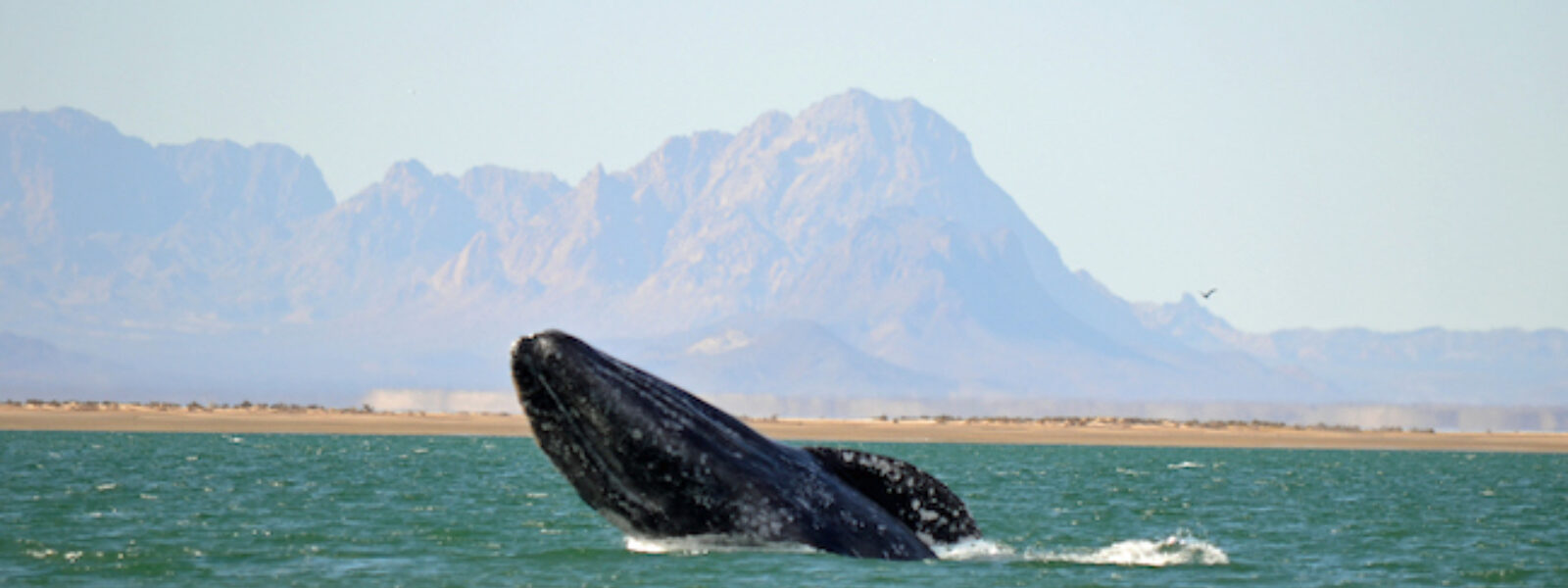
Why IMMP Is Going to Court to Save Gray Whales?
By Abigail Wadkins-Daub
Abigail is an intern with the International Marine Mammal Project at the Earth Island Institute and a recent graduate of the University of San Francisco.
**********************************
On Tuesday, August 25th, the International Marine Mammal Project (IMMP) of Earth Island Institute joined forces with the Center for Biodiversity (CBD) and Oasis Earth in a lawsuit against the National Marine Fisheries Service (NMFS). Why? Exactly one year ago, Rick Steiner of Oasis Earth submitted a petition to relist gray whales under the Endangered Species Act, which the Fisheries Service has failed to respond to.
“The Trump administration has once again broken one of the nation’s bedrock environmental laws — the ESA — by failing to respond to our August 2025 petition to list gray whales under the Act. NOAA’s own science shows the gray whale population to be in grave danger due to Arctic climate change and other threats, and the government is now required to afford the whales all additional protections provided by the ESA.” - Professor Rick Steiner, founder of Oasis Earth
A Conservation Success Story in Reverse
Gray whales were once celebrated as one of conservation’s greatest success stories. In the late 19th and early 20th centuries, Eastern Pacific gray whales were hunted to the brink of extinction due to intense demand for lamp oil and other products produced from whale blubber. In response, gray whales received protection from the International Whaling Commission in 1947. The United States responded by adding gray whales to both the Marine Mammal Protection Act and the Endangered Species Act, while Mexico transformed some of Baja’s major breeding and nursing lagoons into protected refuges.
These recovery efforts proved remarkably successful, and by the 1990s, Eastern Pacific gray whale populations had rebounded to an estimated 26,960 individuals. In 1994, they were delisted from the U.S. Endangered Species List.
Today, however, that recovery is unraveling, with population estimates falling as low as 12,000 individuals in 2024. More severely emaciated whales are being observed, many of which have washed ashore. These strandings, which have increased to 187 this year, represent only a fraction of all mortalities, as roughly 10 whales die offshore for every one found stranded. In the past decade, the gray whale population has declined by as much as an estimated 50%.
That's why the International Marine Mammal Project is joining legal action to seek Endangered Species Act protections for Eastern North Pacific gray whales once again.
What's Causing This Decline?
This troubling trend in gray whale populations can largely be attributed to rapidly changing climate conditions. For one, the Arctic is warming rapidly, where gray whales spend half the summer feeding in nutrient-rich waters. This warming has changed the abundance and distribution of their prey, which may explain why so many emaciated gray whales are being observed.
Additional human-caused ocean disturbances contribute to population declines. As sea ice melts, the Arctic has become increasingly accessible to human activity, including shipping, offshore oil and gas development, undersea mining, commercial fishing, tourism, and coastal development. As these industries continue to grow, they introduce additional pressures on an already stressed ecosystem. Along the migration route of gray whales, increased vessel traffic raises the risk of ship strikes and underwater noise pollution, while expanding industrial activity can contribute to habitat degradation, pollution, and other disturbances that threaten marine mammals. Gray whales can also become entangled in plastic fishing gear during migration.
What Would Endangered Species Act Protection Actually Do?
The Endangered Species Act protects threatened and endangered species by prohibiting harm, safeguarding critical habitat, and requiring science-based recovery plans. An ESA listing would also bring greater public recognition to the plight of gray whales and create stronger incentives for industries, including fishing and shipping, to avoid killing or harming them.
Listing could also bring additional funding and resources for gray whale conservation, improve enforcement of existing protections, and alert other federal agencies whose activities impact gray whales, such as the U.S. Navy, that the species is in need of protection. While an ESA listing would not solve every problem gray whales face, it would provide important tools and resources to support their recovery.
IMMP’s Decades-Long Fight to Protect Gray Whales
For IMMP, this lawsuit is the culmination of decades of efforts to protect gray whales.
In the mid-to-late 1990s, IMMP joined the Natural Resources Defense Council (NRDC), Mexican environmental groups, and Homero Aridjis, Mexico’s poet laureate and leader of El Grupo de los Cien, to protect the last pristine calving ground of the Eastern Pacific gray whale. The campaign was launched in response to a proposal by the Mitsubishi Corporation and the Mexican government to build a massive, $120 million industrial salt-processing facility at Laguna San Ignacio in Baja California Sur. After years of public advocacy and organizing, the project was officially canceled on March 2, 2000.
IMMP also helped establish a low-interest loan program that allowed San Ignacio fishermen and tour boat operators to purchase more efficient, less-polluting 4-stroke outboard motors.
IMMP has also worked for decades to reduce the threat of fishing gear to gray whales. In 1990, IMMP endorsed a successful initiative to ban set and drift gill nets in California state waters. In 2014, IMMP joined other conservation groups in advocating for legislation to phase out large-mesh drift gillnets, which were entangling gray whales and other marine life. In December 2022, working with the late Senator Dianne Feinstein, IMMP helped support Congressional legislation to phase out California’s offshore drift gillnet fishery.
IMMP has further led efforts to stop offshore oil drilling in sensitive ocean habitats along the Pacific Coast and in Alaska, helping block new leasing in critical areas used by gray whales.
For IMMP, seeking Endangered Species Act protection is the next step in a decades-long effort to protect gray whales.
Why is IMMP Going to Court?
The ESA allows organizations and individuals to petition the federal government to list species that are in danger of extinction or likely to become so.
IMMP and its partners are seeking federal action because the available evidence shows that Eastern North Pacific gray whales are experiencing a serious decline. They need the protections the ESA provides to prevent further decline, avoid extinction, and support meaningful population recovery.
On August 25, 2026, plaintiffs IMMP, CBD, and Oasis Earth submitted a notice of intent to sue the Secretary of Commerce and the National Marine Fisheries Service (NMFS) if they do not remedy violations of the Endangered Species Act within 60 days.
Specifically, NMFS must issue both a 90-day finding and a 12-month finding on Professor Rick Steiner’s 2025 petition to relist Eastern Pacific gray whales under the Endangered Species Act. NMFS received the petition on August 24, 2025. The agency should have issued its 90-day finding by November 24, 2025, and its 12-month finding by August 24, 2026.
However, to date, the Trump administration has been unwilling to take any action on the petition, filed a year ago, by Professor Steiner. IMMP is working with Steiner, whose organization Oasis Earth is also a plaintiff in our lawsuit, to move the listing forward.
A lawsuit is our last best hope for the gray whales at this time. We have issued notice that we will sue the National Marine Fisheries Service in 60 days unless they take action on the petition.
Gray whales have recovered from the brink of extinction before. With meaningful protections and continued conservation efforts, we can help ensure they have a future in our oceans.
******************************
The Center for Biological Diversity is a national, nonprofit conservation organization with more than 1.8 million members and online activists dedicated to the protection of endangered species and wild places.
Oasis Earth is a marine conservation organization located in Anchorage, Alaska. (www.oasis-earth.com)
The International Marine Mammal Project (IMMP) of Earth Island Institute is dedicated to protecting whales and dolphins globally.
Oasis Earth, the International Marine Mammal Project, and Earth Island Institute are represented by Greenfire Law, PC, a public interest environmental law firm located in Berkeley, California.
Learn more:
- Read the official press release: IMMP and CBD Launch Lawsuit to Protect Imperiled Gray Whales
- Learn more about declining gray whale populations: Gray Whales Are Disappearing Again
- Learn more about warming Arctic conditions and their impacts on marine mammals: As Arctic Ice Disappears, Marine Mammals Face a Crisis
***************************************
Your support for the International Marine Mammal Project (IMMP) of Earth Island Institute is more important than ever. From gray whales to right whales to saving thousands of dolphins from tuna nets, your donations go directly to help these amazing sentient beings of the ocean. Please consider a generous donation today. Thank you!