Saving the North Atlantic Right Whale
By Mark J. Palmer
The North Atlantic right whale (Eubalaena glacialis) barely survived extinction, as whaling was conducted in the Atlantic Ocean since before Europeans discovered North America into the 20th century. In 1935, the League of Nations banned the hunting of right whales, but enforcement was lax, and right whales continued to be killed until whaling ships were sunk during World War II.
Right whales were finally protected from whaling in the oceans of the world in 1946 by the International Convention on the Regulation of Whaling, which established the International Whaling Commission. Still, killing right whales occurred in several places when no one was watching, and “pirate” whaling was conducted by vessels not beholden to the IWC.
Fortunately, despite killings here and there, the North Atlantic right whale, migrating up and down the East Coast of the US and Canada, began to recover from early whaling efforts. It was slow at first, but by 1950 scientists began spotting right whales in areas where they had previously been missing. Scattered sightings of right whales continued, but systematic studies of the whales really began after the passage of the US Marine Mammal Protection Act (MMPA) in 1972.
Alarmingly, beginning in 1988, deaths of right whales started to increase, and greater numbers of right whales were found dead, washed up on beaches.
Human activities were responsible -- ship strikes and entanglement in fishing gear, especially plastic ropes connected to lobster and crab traps. Some experts believe only one-third of right whale deaths are discovered by scientists, a worrisome number for such a depleted population.
From 1970 to 1990, nearly one-third of all right whales found dead showed scars from ship strikes and propellers. Right whales feed by skimming the surface and shallow depths with their mouths open, sucking in seawater filled with krill and other small creatures. The water is then flushed out through the whale’s baleen plates, which act as a sieve to capture the small sea animals, which are swallowed.
At the surface, right whales are struck by large and small vessels moving too fast for the whales to avoid a collision. Similarly, when swimming, right whales encounter horizontal plastic ropes that connect buoys on the surface with crab and lobster traps below. These ropes get caught in the whales’ mouths and around their bodies and the base of the tail.
A huge problem is that right whales reproduce very slowly, birthing a calf once every six to ten years. With approximately only 70 females of reproductive age, the number of deaths often exceed the number of births, and the population is believed to be slowly declining towards extinction.
Fishing and ship traffic are important economic engines for the East Coast, and the constituents carry large political clout.
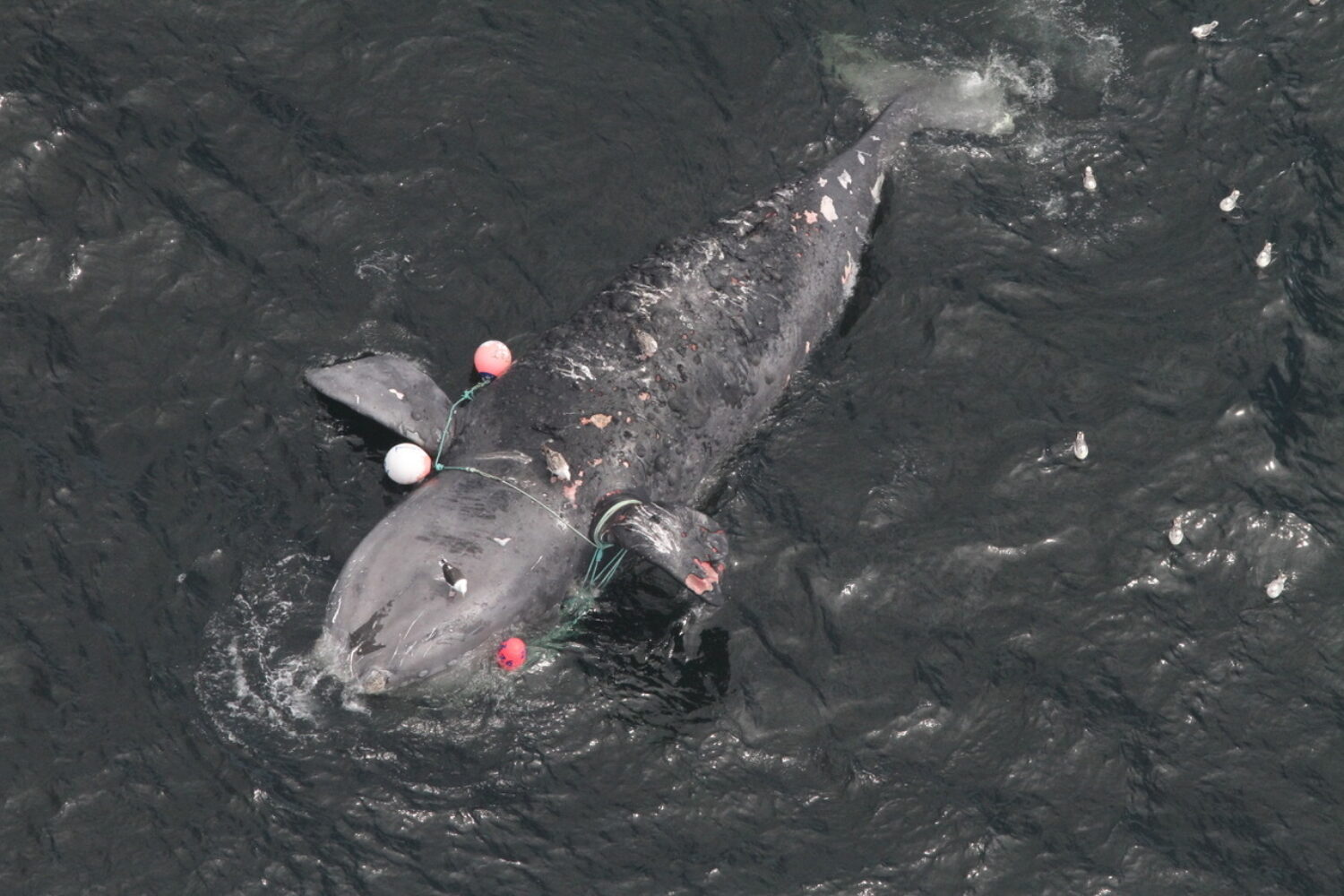
An entangled right whale. Photo Credit: Peter Duley, Northeast Fisheries Science Center, NOAA, Collected Under MMPA Permit # 17355
But solutions don’t have to be complicated or difficult to enforce, if the shipping and fishing industries cooperate in developing alternatives.
Most experts believe slowing vessels to 10 knots (nautical miles per hour) is sufficient to give ships and whales time to avoid collisions, and the US National Marine Fisheries Service (NMFS), charged with enforcing the MMPA for cetaceans, has imposed a 10-knot speed limit for large vessels in right whale waters. NMFS has also set up an early warning system whereby locations of right whales are marked and reported to shipping traffic.
New regulations have been proposed by NMFS that would reduce speeds of smaller boats, like recreational motor vessels and fishing boats, to 10-knot speeds to afford protection to right whales (calves especially seem susceptible to collisions from even small boats traveling at high speeds). This proposal, unfortunately, has been targeted by extremist groups, some fishermen, and members of Congress who contend that the reduced speed limit would harm fishermen, coastal economics, etc. It is hard to impose speed limits on boaters used to deciding their own speeds at sea.
Even more contentious is a replacement for the plastic lobster and crab ropes that form a huge hazard to whales. New ropeless fishing gear designs are being tested, boosted by government subsidies that the International Marine Mammal Project and other advocates have helped push through Congress.
The idea is to have the crab or lobster trap sink to the bottom, with a buoy and coiled rope attached. An electronic signal from the fisherman above releases the buoy, which floats to the top attached to the rope, and the trap can then be hauled on board and reset.
The technology is promising, and experiments continue to tinker with designs to make sure the traps prove effective for fishing. However, the new traps do cost more than current traps attached to a surface buoy, so it seems likely government subsidies will be necessary to speed adoption of the gear, once it becomes practical to deploy.
Significantly, rather than pushing to stop fishing and boat traffic in areas used by the North Atlantic right whale, environmentalists are advocating for a solution that protects both the whales and the local fishing and shipping businesses. With modified fishing gear and reduced vessel speeds, Atlantic right whales can recover, while fishing and shipping interests can also thrive. It’s a win-win.
*********************************
Many excellent organizations are working to protect North Atlantic right whales, with only around 360 animals left in the entire population. Even the loss of one right whale is a blow to the small population. We encourage you to donate to the work of the International Marine Mammal Project and other organizations working to protect whales and dolphins. Thank you for your donation!