Administration Wants to Speed Up Ships in Whale Habitat
By Cindy Lowry
Maine Campaign Coordinator for North Atlantic Right Whales International Marine Mammal Project
I have spent more than twenty years working to protect marine life, from the coast of Alaska to the Gulf of Maine, where I live now. I have helped rescue gray whales trapped under Arctic ice. I have lobbied Congress, litigated on behalf of animals, and watched what happens when an industry's interests outweigh a species' survival.
In March, the US National Marine Fisheries Service (NMFS) announced it is considering replacing the North Atlantic right whale vessel speed rule (mandatory limits requiring large ships to slow to 10 knots in designated areas along the East Coast) with what it calls "technology-based, strike-avoidance measures."
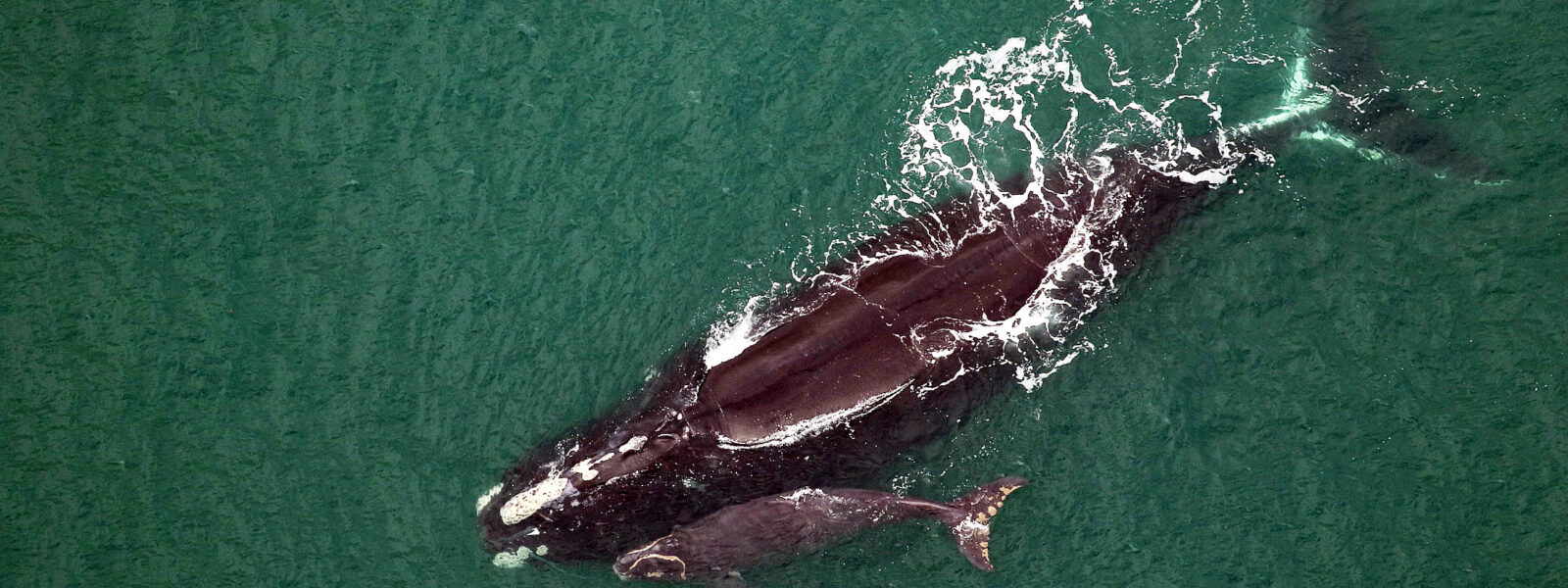
There are approximately 380 North Atlantic right whales left. Among them, only about 70 are reproductively active females. That is the entire reproductive future of the species. Vessel strikes and entanglement in fishing gear are the two leading causes of death. The speed rule was put in place in 2008 to reduce vessel strike risks to the whales. It is imperfect, as strikes still happen, and I would be the first to say the rule could be strengthened, but it is the only structural protection they have against the ships that steam right through their migratory route.
The administration's proposal would replace it with “dynamic, technology-driven slow zones triggered by real-time whale detections.” In theory, this sounds like progress. But in practice, the technology to make it work reliably doesn't exist at scale.
Between 2017 and now, 27 right whales were killed or injured by vessel strikes, and those are only the deaths we know about. Approximately 64% of right whale deaths from any cause are never recorded.
If we cannot count the losses reliably, the idea that we can detect individual whales in real time and trigger automated slowdowns before a collision becomes even harder to believe.
The agency recently commissioned a Technology Readiness Level report from The MITRE Corporation assessing the maturity of various whale-detection technologies. The findings are not encouraging. Many of the approaches under consideration — satellite imaging, LIDAR, advanced radar — were found to be at low readiness levels, still in research and development stages, nowhere near ready for operational deployment at sea. Even passive acoustic monitoring, one of the more established tools, has significant limitations in real-world conditions.
The TRL scale runs from one to nine. Nine means ready to deploy. Several of the technologies the administration is counting on to replace mandatory speed limits are sitting at two and three.
The administration is also leaning on the existing voluntary slow zone program as evidence that a softer approach can work. But voluntary compliance is not a substitute for mandatory rules, especially when the stakes are existential. Voluntary slow zones have coexisted with the speed rule for years. The data on mariner compliance with those zones, even when right whales are known to be present, clearly threatens the lives of right whales and threatens the species with extinction, not at all reassuring.
What troubles me about this proposal, in addition to what it would do to the right whales, is the logic underneath it. This species has no margin for increased risk. You cannot run a pilot program on a species this close to the edge and call it conservation. The Endangered Species Act is clear that economic considerations should not drive biological decisions made to protect a species from extinction. Every additional vessel strike is not a data point. It is an animal whose life matters, and whose loss the species cannot afford.
What You Can Do:
The public comment period on this proposal closes Tomorrow, June 2, 2026.
Comments can be submitted at https://www.regulations.gov/search?filter=NOAA-NMFS-2026-0364 or by searching www.regulations.gov for docket number NOAA-NMFS-2026-0364.
I would encourage anyone who has ever been moved by the sight of a whale, or by the idea that we should not be the generation that watches this species disappear, to say so on the record.
The Trump administration has framed this as “modernization”. But modernization means upgrading to something better, not dismantling something proven in favor of something theoretical. The right whale doesn't need a smarter algorithm. It needs ships to slow down. We already know how to do that. The only question is whether we're willing to keep doing it and not let this vulnerable species slip into extinction.
*********************************
You can also help by donating to the protection of right whales, as well as other whales and dolphins around the world. The International Marine Mammal Project of Earth Island Institute is working to protect these amazing beings. Please help with a donation!