Diving Deeper into the Whale Sanctuary Project with Dr. Lori Marino
Interview by Jessica Boswell
Jessica is a recent graduate of the University of California, Santa Barbara, and an intern with the International Marine Mammal Project (IMMP) of Earth Island Institute. At IMMP, Jessica has authored blogs interpreting novel scientific literature, synthesized and modeled data on dolphin hunting, and researched the impacts of plastic on marine mammals in 2023.
IMMP’s Executive Director David Phillips is a member of the Board of Directors of the Whale Sanctuary Project.
Dr. Lori Marino is a distinguished neuroscientist renowned for her research on cetacean cognition, intelligence, and emotion. She works to bridge the gap between science and advocacy by bringing cutting-edge research to the forefront of her efforts to end the captivity of whales and dolphins. As a founder of both the Whale Sanctuary Project and The Kimmela Center for Animal Advocacy, Dr. Marino has dedicated her career to understanding and improving the lives of animals worldwide.
Q: What makes sanctuaries such an important part of the solution to captivity?
Dr. Marino: Almost all dolphins and whales in entertainment parks have either been born there or have been there for a very long time. As such, they don’t have the skills, e.g., hunting prey, etc., they need to survive in the open ocean. Moreover, they don’t have a family or social group to return to. So, the only way to move them out of the tanks is to transfer them to sanctuaries. In sanctuaries they can live in the ocean, have a more interesting life, be autonomous, but also be fed and cared for. It is the only solution for captive whales and dolphins. Eventually we would like all captivity – including sanctuaries – to end.
Q: What is the current status of the Whale Sanctuary Project?
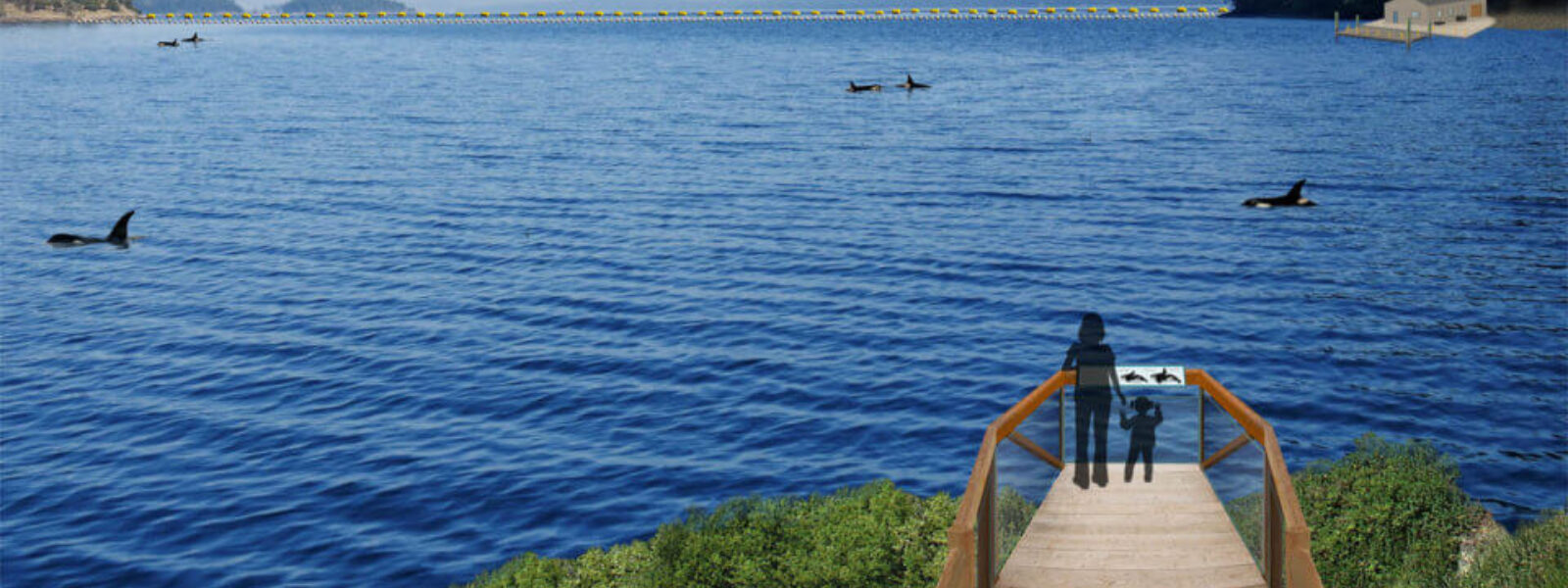
Dr. Marino: We have completed our Environmental Assessment III and are poised to submit our request for a permit from the Nova Scotia authorities. We have also begun work on a bay-pen to initially house the residents, location of water wells and other points of infrastructure, and are ready for development of the buildings on land. We are fast tracking our work so that we can be ready to receive whales by 2025.
Q: Based on preliminary environmental assessments, how many whales, or marine mammals in general, do you expect to house in the sanctuary? Which species would be suited for the sanctuary?
Dr. Marino: Our sanctuary is the only one in the world designed to provide a permanent home for both belugas and orcas. We would separate the species. We would be able to bring 2-4 orcas and 6-8 beluga whales to our sanctuary (with a little bit of flexibility). If we had all beluga whales, we could probably house about 10-12. We would not want to exceed the carrying capacity of the site (i.e., how much animal waste can be flushed through the site).
Q: Is there a chance that residents of the seaside sanctuary could be released back into the wild eventually?
Dr. Marino: We aren’t planning for the residents to be released into the wild. They will have a permanent home at the sanctuary.
Q: Will the project require any alteration of the natural ecosystem in order to make it a suitable habitat for these animals?
Dr. Marino: There will be a perimeter net held in place by pylons driven into the submerged soil. Other than that, there will be structures on the land side. We’ve completed several years of assays to ensure that there are no endangered species in that area and that we would not be harming any of the environment.

Beluga whale. Photo Credit: Shutterstock
Q: How have the indigenous people of the area played a role in the establishment of this sanctuary?
Dr. Marino: The indigenous people in Nova Scotia are the Mic’ma, and they have been involved in every step along the way. We conducted surveys to ensure the land we use for the sanctuary isn’t sacred land to them. They have been with us for all of our milestones and recently wrote a letter of endorsement for us. We plan to include indigenous culture in our outreach and education.
Q: Even after major shifts in public opinion, like those that came from Blackfish and the death of Lolita, people continue to line the pockets of SeaWorld and other captivity operations. Do you believe there is something missing from advocacy efforts that, if implemented broadly, could correct this discrepancy?
Dr. Marino: I do think that one of the things missing is the fact that there is still no alternative to the concrete tanks. That’s why it is so vital to create sanctuaries. We need many of them.
Q: How have SeaWorld, MarineLand, or other captivity organizations reacted to the sanctuary project? What is your response to them?
Dr. Marino: There is a mixture of reactions to the sanctuary. Most of the entertainment parks, and especially SeaWorld, are staunchly against them. They are seen as a threat. Some, like Marineland Antibes in France or the dolphinarium in Brussels, have made the decision to end their dolphin and whale captive entertainment and are looking for places to send their animals. We maintain an open line of communication with everyone who will speak with us – even those who don’t like sanctuaries. If we close down communication, we close down any possibilities of bringing whales to the sanctuary.
Q: What brought you into the field of cetacean research and how has the field changed since you began your work?
Dr. Marino: I started out interested in brains and how they are related to intelligence in other species. It was not until graduate school that I decided to study dolphins. I was in the library and saw a photo of a dolphin brain and was so impressed that I knew then that I wanted to focus on cetaceans – their brains, evolution, function, intelligence, self-awareness. When I started out a lot of research was being done on dolphin cognition. That has changed. While there are still some dolphin labs, a lot of work has shifted to conservation and behavior of wild dolphins and whales. I consider that a positive change.
Q: What inspired you to create the Whale Sanctuary Project?
Dr. Marino: I was inspired to create the Whale Sanctuary Project because I knew how much these animals were suffering in entertainment parks. The science was clear. And I saw that there were sanctuaries for other species and felt that there was no reason for there not to be sanctuaries for captive dolphins and whales. I got a group of people together in 2016 and we eventually became the Whale Sanctuary Project.
For more information on the Whale Sanctuary Project, go here.