How “Pop-Up” Fishing Gear Offers Hope to Whales and Fishers
By Abigail Wadkins-Daub
Abigail is an intern with the International Marine Mammal Project at Earth Island Institute and a graduating senior Environmental Studies student at the University of San Francisco.
Every year, whales become entangled in fishing gear off the coasts of California and the Northeastern United States. Many drown immediately, while others drag heavy ropes and traps for months or years as the lines cut into their flesh, leaving them exhausted, starving, and slowly dying.
As ocean warming and shifting prey availability alter whale migration and feeding patterns, whales are appearing in unexpected places and lingering longer in coastal waters. This overlap between whales and commercial fisheries has made entanglements more difficult to predict and prevent. In response, fisheries are increasingly forced to close during periods of high whale presence. While these closures help protect whales and other marine life, they also leave many fishers without income. As ocean conditions continue shifting, many scientists, conservationists, and fishers agree that fishing closures alone are not a long-term solution.
The Problem: Whale Entanglements & Fishery Closures
Traditionally, crab pots are tethered to surface buoys with vertical ropes that remain suspended throughout the water column. These lines can entangle whales, sea turtles, and other marine animals.
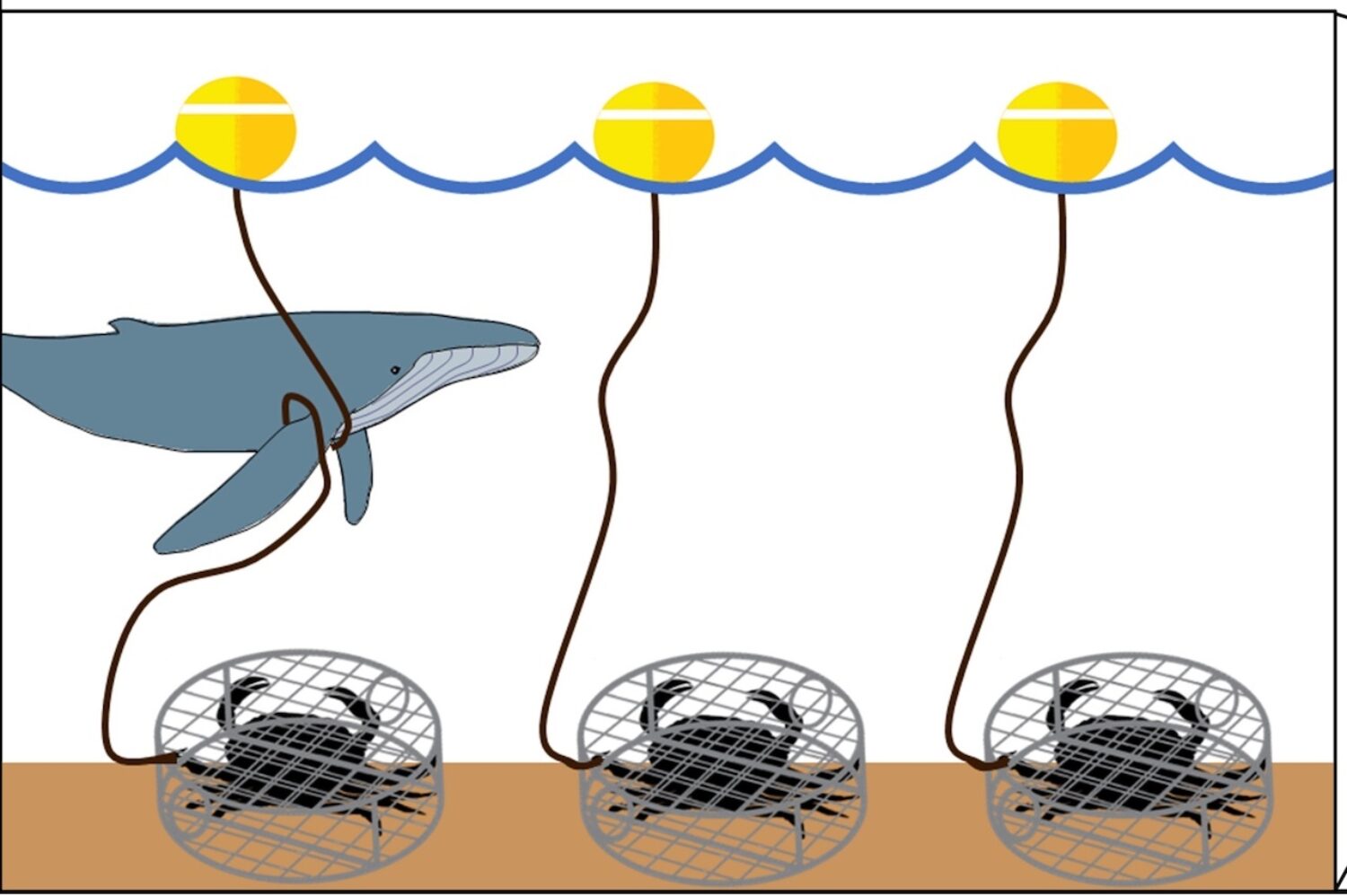
Illustration Credit: Reikkola, L., Biological Conservation: Vol 278 (2023)
In the Northeastern United States, fishing gear entanglement is the leading cause of death for the critically endangered North Atlantic right whale. 85% of the remaining population have been entangled in fishing gear at least once in their lifetime, often with scarring. About 60% have been entangled multiple times. With only around 380 individuals left, even a small number of deaths can have devastating impacts on the species’ survival.
Entanglements are also a major issue for the humpback and gray whale populations along the West Coast of the US, where crab fishing is a major industry. Gray whales are especially vulnerable to both entanglements and ship strikes, with populations declining to roughly half of what they were in the 1990s.
Because of these risks, fisheries are increasingly closed during periods of high whale presence, creating major economic challenges for coastal fishing communities. An alternative fishing method for crabs, lobsters, and spot prawns is urgently needed.
The Development of Pop-Up Fishing Gear
Bart Chadwick, a PhD-trained oceanographer from the Scripps Institution of Oceanography, has spent his career developing ocean monitoring tools. Today, he is adapting that same technology to reshape the future of commercial fishing.
Chadwick is the co-owner of Sub-Sea Sonics, a company focused on making ocean technology more accessible and environmentally sound. At the center of this work is “pop-up” fishing gear, also known as “ropeless” or “whale-safe” gear.
Unlike traditional crabbing systems, pop-up fishing gear keeps the rope and buoy stowed on the seafloor until a fisherman triggers the system acoustically from the boat. Once activated, an inflatable lift bag or buoy carries the line to the surface for retrieval. Without vertical ropes constantly suspended in the water column, the risk of whale entanglement is significantly reduced.
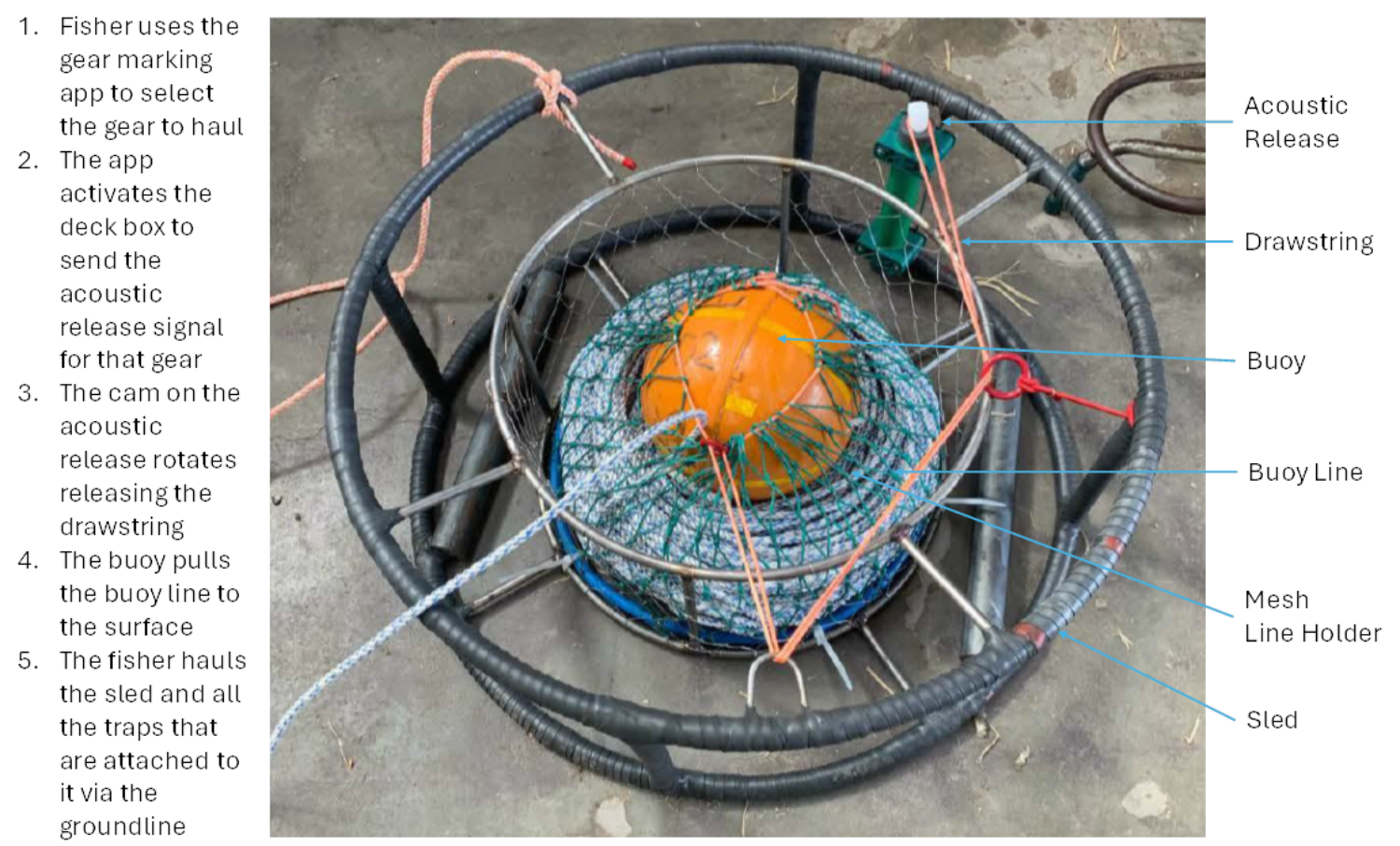
Pop-up Fishing Gear. Photo Credit: Sub Sea Sonics, San Diego
Chadwick first used similar technology during his time in the U.S. Navy, where it allowed researchers to retrieve expensive equipment from the seafloor. After leaving the Navy, he began adapting these systems for use in commercial fishing.
While the gear can help fishers continue operating safely during periods of high whale presence, its broader goal is to reduce reliance on vertical fishing lines across fisheries altogether. Advocates see the technology as a potential bridge toward stronger rope regulations in seasonal closures, whale hotspot areas, and eventually more broadly throughout commercial fisheries.
Testing the Technology
Over the course of three years, the gear was tested under an experimental permit in California. The first two years saw limited participation, with just two fishers involved in the first year and 18 in the second year.
The third year presented additional challenges, with poor crabbing conditions that complicated the trial. However, these conditions also highlighted one of the gear’s key advantages. Along the West Coast, nutrient-rich upwelling draws both whales and fishers to the same productive waters. When crabs and whales concentrated near Point Reyes, for example, fishers using pop-up gear were still able to operate safely.
The trials also demonstrated that the technology could function reliably under real commercial fishing conditions, despite claims from some fishing industry groups that the systems are impractical or ineffective. As of December 2025, pop-up gear officially entered commercial use following authorization by the California Department of Fish and Wildlife.
Hesitations and Resistance Facing Pop-Up Gear
Despite this progress, widespread adoption still faces significant barriers, with cost being one of the most immediate challenges. Because adoption remains limited across fisheries, some fishers are hesitant about the upfront investment. However, several California fishers involved in the trials reported recovering costs relatively quickly by maintaining fishing access during periods of whale presence. Future subsidies and financial support programs could also help make adoption more accessible.
For many years, the International Marine Mammal Project of Earth Island Institute and its colleagues have successfully supported Congressional efforts to fund experimental gear in right whale waters on the East Coast, including subsidies that help reduce costs for fishers testing the technology.
Cultural and social dynamics also play a major role, as many fishers view the gear as unfamiliar and difficult to integrate into existing practices. Others worry that voluntary adoption could eventually lead to broader regulations requiring pop-up gear beyond seasonal closures.
Early adopters have also faced pushback within their own communities. Chadwick notes that some fishers testing the gear experienced intense criticism and even threats, reflecting the deep influence of tradition and economic uncertainty within the industry. Although many entered the trials skeptical of the technology, their continued participation and feedback helped refine the systems, demonstrate their reliability in commercial fisheries, and ultimately move the gear from the experimental phase to authorization.
These concerns extend beyond California to the Northeast United States, where pop-up gear is also being tested in the region’s $500 million lobster industry to protect endangered North Atlantic right whales.
Looking Ahead
At its core, Chadwick believes this divide comes down to building trust. While many fishers initially view pop-up gear as a threat to their livelihoods, routines, and culture, he believes collaboration can create new ways for fishers to remain on the water while reducing risks to whales.
As whale entanglements continue and ocean conditions shift, technologies that reduce reliance on vertical fishing lines are vital for the future of marine mammals and commercial fisheries.
*************************************
The International Marine Mammal Project (IMMP) of Earth Island Institute has made significant progress in reducing the dangers that fishing gear poses to whales, dolphins, sea turtles, sharks, and other marine life. Promoting pop-up gear, while helping fund experiments and subsidies for fishermen, is an important step toward preventing entanglements in crab and lobster gear for gray, fin, and humpback whales in California and for the North Atlantic right whale on the East Coast. Please help the great whales avoid entanglement with a donation to IMMP. Thanks for your support.